


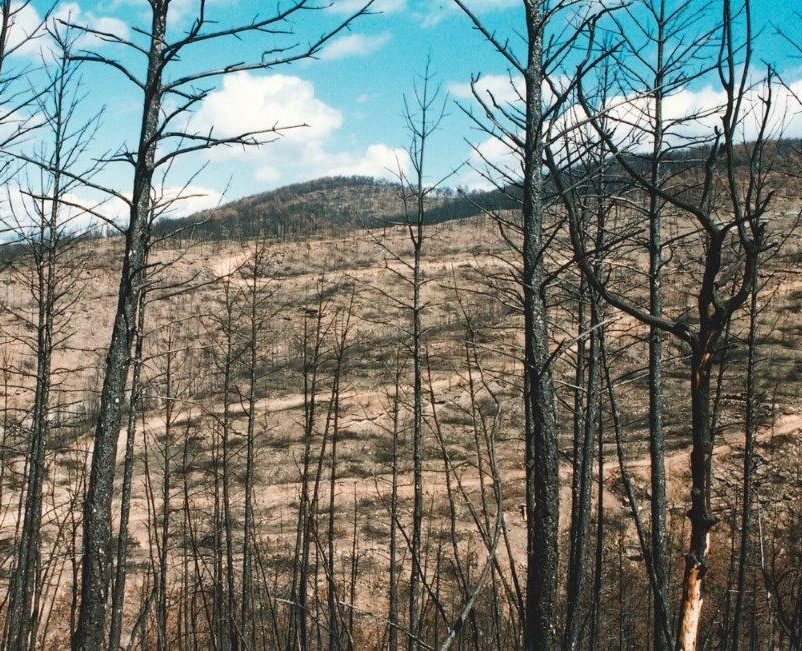
This is the conclusion of a study published today in Science, with participation from several Catalan institutions, including CREAF, CTFC, and the University of Girona.
The Mediterranean is one of the most vulnerable regions, and nearly 90% of its forested area could experience an increase in these disturbances.
Among the consequences, forests will become increasingly younger and less capable of acting as carbon sinks.
Despite these findings, the team offers a message of hope: if greenhouse gas emissions are significantly reduced, the increase in forest disturbances could be limited to around 20%.
A new study published today in Science warns that, without a significant reduction in emissions, forest disturbances—including wildfires, insect outbreaks, and windstorms—could double before the end of the 21st century compared to the 2001–2020 period. The research was led by the Technical University of Munich (TUM) and involved several Spanish institutions, including the Forest Science and Technology Centre of Catalonia (CTFC), CREAF, and the University of Girona.
According to the study, the disturbances expected to increase the most are wildfires, as the annual burned area in Europe could nearly triple by the end of the century, making events previously considered extreme increasingly common. Insect outbreaks are also projected to rise by nearly 50%, especially wood‑boring beetles that feed on timber. Rising temperatures accelerate their reproductive cycles, allow them to expand into areas previously limited by cold, and enable them to attack weakened forests. Windstorms are projected to increase slightly, but are considered less concerning.
“One worrying aspect is that these projections are not compared to distant, stable historical periods, but to a recent period (2001–2020) that has already been the most intense in disturbances over the past 170 years. In other words, the starting point is already very high, and yet the study shows the situation could worsen even further,” explains Josep Maria Espelta, CREAF researcher and co‑author.
To conduct the study, the team worked with the three climate scenarios defined by the IPCC and projected forest evolution from 2020 to 2100 under each one: “in all three scenarios, disturbances increase, but with large differences.”
The Mediterranean Region at Highest Risk
According to the data, the Mediterranean stands among the most vulnerable areas, and nearly 90% of Mediterranean forests could be affected by more fires and pest outbreaks under high‑warming scenarios. “The reason is the combination of drought, heat, and young, homogeneous forests where agricultural and pastoral activities have been abandoned, eliminating the mosaic landscape that once helped slow fire spread,” adds Espelta. Rising temperatures also weaken Mediterranean trees, and some pests—such as bark‑boring beetles that particularly affect conifers, including Ips typographus—attack more aggressively and can cause mass mortality events. “Even though it is a native species, if its population increases dramatically, it destroys the bark and wood to the point that the tree can die,” warns Espelta.
Other highly vulnerable regions identified in the study include western France, the British Isles, and the Carpathians, “although overall, no region is spared and all of Europe will experience an increase in these phenomena.”
Fewer Old‑Growth Forests and Less Carbon Storage
The study also predicts that increasing forest disturbances will reduce the already scarce old‑growth forests in Europe—currently only about 3% of the total—while young forests will expand, especially in Mediterranean and temperate regions. This shift could have major consequences, including reduced forest capacity to absorb CO₂ and act as carbon sinks, loss of key habitats for biodiversity associated with mature forests, and socioeconomic risks affecting forest management, wildfire prevention, and local economies dependent on forestry.
The team also identifies areas that could act as refuges and help preserve old‑growth forests, such as the Pyrenees, other Mediterranean mountain ranges, and northern Europe, “although they would be insufficient to compensate for the loss.”
A Ray of Hope
Despite the alarming data, the study also offers a positive message: ambitious emissions reductions could limit the overall increase in forest disturbances to around 20%, far below the levels projected under non‑mitigation scenarios. “This shows that climate action is crucial and that there is still room to reduce impacts,” concludes Espelta.
The researchers emphasize that these results assume a continuation of current forest management practices. But if emissions reductions are combined with forest management strategies better adapted to climate change, forest resilience can be strengthened and more resilient forest landscapes can be promoted. According to Jordi Garcia‑Gonzalo, CTFC researcher, “the recent development of decision‑support tools allows us to design optimized management plans that maximize carbon absorption both in forests and in wood products. This would minimize wildfire risk and increase the resilience of our forests, ensuring the provision of ecosystem services such as blue water supply. Ultimately, it’s about developing climate‑smart management that delivers better outcomes.”
The study was led by the Technical University of Munich (TUM) with participation from research centers across Europe, including CREAF, CTFC, and the University of Girona, as well as the University of Vermont in the United States, CSIRO in Australia, and ETH Zurich.
Reference article: Grünig, M.; Rammer, W.; Senf, C. et al: Climate change will increase forest disturbances in Europe throughout the 21st century, Science 2026. DOI: https://doi.org/10.1126/science.adx6329
Last modified: 6 March 2026