


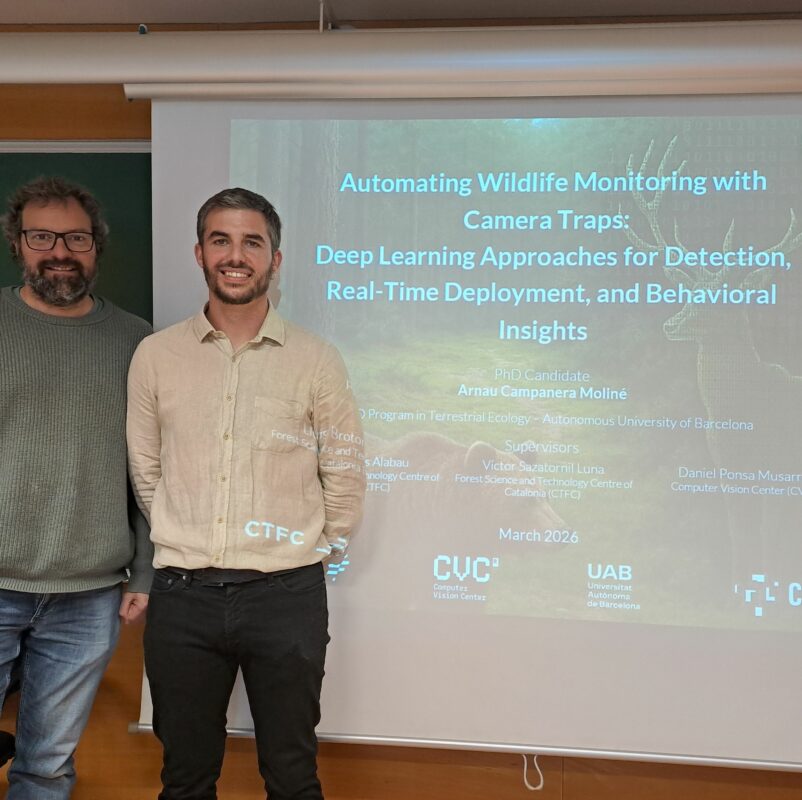
The research supports the use of computer vision models to detect wildlife and analyze behavior in real time.
Arnau Campanera has defended his doctoral dissertation at the Faculty of Biosciences at the Autonomous University of Barcelona (UAB). The research, carried out at the Forest Science and Technology Centre of Catalonia (CTFC) under the supervision of Lluís Brotons, Víctor Sazatornil (CTFC) and Daniel Ponsa from the Computer Vision Center (CVC-UAB), introduces new deep‑learning tools designed to enhance wildlife monitoring and support conservation decision‑making.
The dissertation, titled Automating Wildlife Monitoring with Camera Traps: Deep Learning Approaches for Detection, Real-Time Deployment, and Behavioral Insights, addresses one of today’s major ecological challenges: managing and analyzing the massive amounts of data generated by camera traps and other monitoring technologies.
YOLO models for fast and accurate wildlife detection
Campanera evaluated the potential of several variants of the YOLO architecture—one of the most widely used computer vision models for object detection—using a dataset of wildlife images that includes multiple species. The research establishes a solid baseline performance and explores optimization strategies that improve detection without requiring additional training data.
The results show that YOLO‑based models deliver strong performance in ecological settings, and that tuning hyperparameters is more effective than increasing domain specificity through color‑based dataset partitioning.
A real-time monitoring system tested in the field
One of the most innovative aspects of the dissertation is the development and field testing of a real‑time wildlife monitoring system that integrates camera traps with cellular connectivity and the optimized model. This system enables near real‑time detection of animals, opening the door to management and conservation applications that require rapid response.
The research also combines pose‑estimation models with a multilayer perceptron to infer the behavior of species such as bears, demonstrating that it is possible to identify patterns like bipedal posture from images. This approach offers new opportunities to study animal behavior without direct observation. The dissertation provides practical guidance on the strengths and limitations of these methodologies and contributes to advancing the use of technology in biodiversity conservation.
Last modified: 1 April 2026