


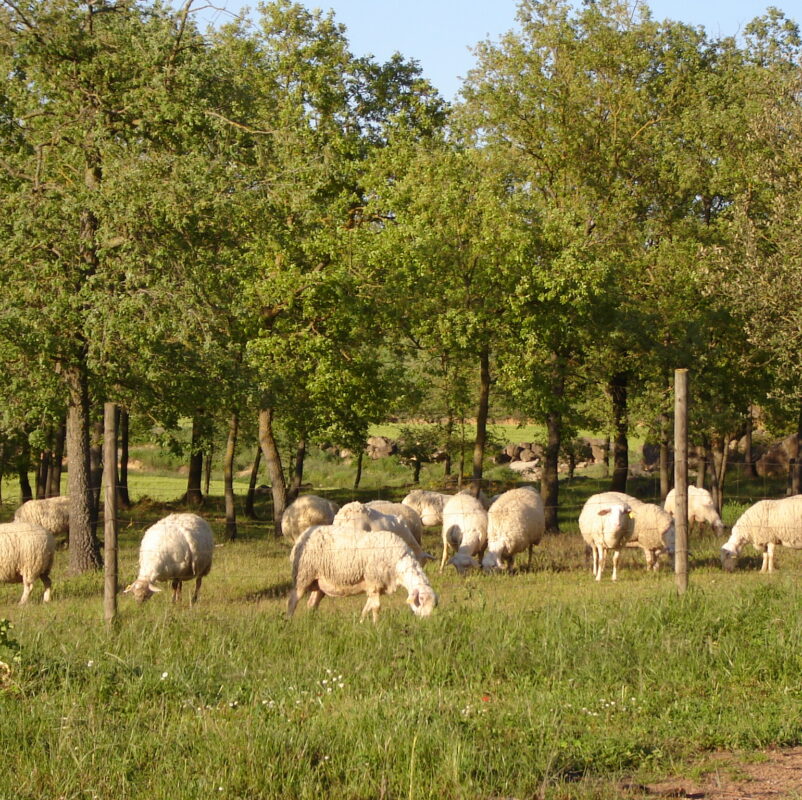
An innovative model that places livestock at the center of wildfire prevention and landscape planning in Catalonia.
SilPas identifies areas where grazing can function as a natural firebreak and improve land management in the face of climate change.
Catalonia has a new ally in addressing one of its most serious environmental threats: large wildfires. SilPas is an innovative tool developed by the Forest Science and Technology Centre of Catalonia (CTFC) within the framework of the European LIFE AgroForAdapt project. The tool highlights the role of silvopastoralism—grazing in forested areas—as a key climate change adaptation strategy.
The decline of extensive livestock farming in recent decades has contributed to the loss of mosaic landscapes and the expansion of continuous forest stands, which are far more vulnerable to fire. SilPas was developed precisely to reverse this trend, helping to identify priority areas for grazing-based management and maximizing its impact on wildfire prevention.
Keeping Fire Under Control… with Livestock
SilPas uses multicriteria analysis, publicly available spatial data, and GIS (Geographic Information Systems) techniques to determine where extensive livestock farming can be most effective and feasible. Its added value lies in its ability to:
- Identify critical wildfire risk hotspots, such as grassland–forest interfaces, where grazing can act as a natural firebreak.
- Assign priorities under different scenarios, enabling technicians and public authorities to focus efforts on areas with the highest preventive potential.
- Recognize livestock as a land management tool, supporting the action lines of the Adaptation Plan for Extensive Livestock Farming to Climate Change (PAE) and the Strategic Plan for Extensive Livestock Farming in Catalonia (PEREC).
Beyond Fire: Planning and Resilience
While wildfire prevention is its central focus, the tool also provides valuable support for spatial planning. It can be applied at the county level or within protected natural areas, optimizing herd placement according to productive, economic, or environmental objectives.
In addition, SilPas integrates key variables such as livestock species (cattle, horses, goats, or sheep), pasture quality, and terrain slope, adapting to the realities of the sector. This flexibility makes it a useful tool not only for wildfire risk management but also for enhancing the profitability of extensive livestock farming, recovering abandoned land, and strengthening ecosystem services across the Catalan landscape.
From the Prades Mountains to All of Catalonia
The first pilot application was carried out in the Prades Mountains, one of the areas most vulnerable to large wildfires. However, the tool is designed to be deployed across the entire Catalan territory, leveraging publicly available spatial data and offering customizable scenarios for land managers and public administrations.
With SilPas, Catalonia positions itself at the forefront of integrating silvopastoralism into climate change adaptation policies. Supported by technology and livestock, this approach has the potential to make a decisive contribution to wildfire prevention and to the creation of safer, more resilient landscapes.
About the Project
LIFE AgroForAdapt, running from 2021 to 2026, continues to make progress in promoting agroforestry systems as a key tool for a more profitable, resilient, and sustainable agricultural sector in the Mediterranean region.
The project is co-funded by the European Union’s LIFE Programme and follows a multidisciplinary and transnational approach, involving eight beneficiaries: the Forest Science and Technology Centre of Catalonia (CTFC) as coordinator, Agresta S. Coop, Agroof S. Coop, the Barcelona Metropolitan Area, the Government of Catalonia – Department of Climate Action, Food and Rural Agenda, the Barcelona Provincial Council, the Girona Provincial Council, and the Emys Foundation. The project is also co-funded by the Tarragona Provincial Council and the Rhône–Mediterranean–Corsica Water Agency (France).
Last modified: 16 December 2025