


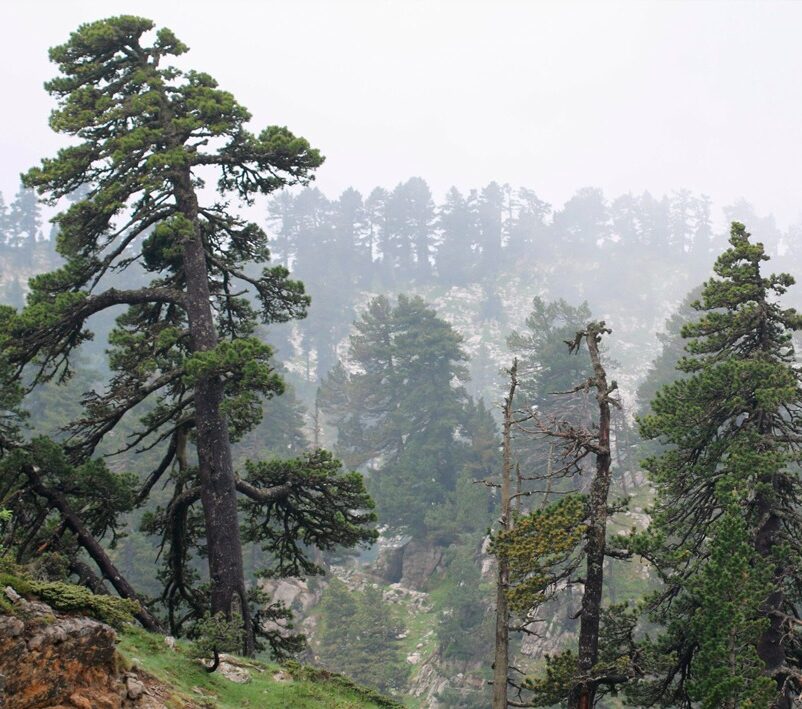
Since 1956, the area covered by these forests has increased by nearly 30%. However, most of them are still young, which limits their ability to withstand droughts, wildfires, and other impacts of climate change.
The analysis also warns that the suitable habitat for mountain pine could shrink by up to 70% by 2040.
According to the team, this assessment has been essential for guiding forest management measures within the LIFE Uncinata* project, which aims to improve the conservation status of this species.
Cerdanyola del Vallès, xxx February. The habitat of mountain pine (Pinus uncinata) forests is protected by the European Union through the Habitats Directive. Forests growing on calcareous soils are considered a priority due to their rarity in Europe. In this context, the LIFE Uncinata* project, coordinated by the Forest Science and Technology Centre of Catalonia (CTFC) with the participation of CREAF, has published the most exhaustive report to date on the state of these forests in the Pyrenees —including Catalonia, Aragon, and Navarre. The report confirms that their surface area has increased in recent decades. Despite this positive trend, the analysis also warns that climate change could reverse the situation.
The comparison of aerial photographs from 1956 with current images shows a significant increase in forest cover, rising from 18% to 45% in some areas. According to the data, this expansion has been especially intense in the lower parts of the mountain range, where forests have colonized former high‑mountain pastures abandoned decades ago. “Despite this increase in surface area, only 9% of the forests show any degree of maturity. Most are still young, dense, and often structurally very homogeneous, which makes them more vulnerable to the effects of climate change,” explains Jordi Vayreda, CREAF researcher and lead author of the assessment.
The team also analyzed the future of these forests under different climate change scenarios. The distribution models show worrying results, as the forests could experience a strong decline due to the lack of suitable climatic conditions. Projections indicate that by 2040, the most suitable areas for this species could shrink by more than 70%. By 2100, under the most severe scenario, the reduction could reach nearly 100%, mainly due to rising temperatures as well as longer, more frequent, and more intense droughts. This could push forests to higher elevations, drastically reducing their presence at lower altitudes and potentially leading to their near disappearance by the end of the century. Forest management focused on conservation could help mitigate this trend.
Aging forests and allowing natural evolution to improve conservation
Although the situation has improved, the study also shows that only 27% of mountain pine forests have a good conservation status. To address this, one of the actions of LIFE Uncinata* is to promote forest maturity —in other words, to “age” the forests. “A mature forest is better equipped to withstand droughts or wildfires, among other disturbances,” adds Vayreda. To accelerate maturity traits, the project proposes measures that mimic natural processes, such as protecting old trees, increasing the amount of large deadwood, and creating small openings in the forest canopy to allow more light in and support other tree and shrub species.
The report also highlights the benefits of minimal forest intervention, which in some areas has allowed forests to evolve naturally. “We have confirmed that allowing forests to evolve freely in certain areas is also one of the most effective strategies to improve their conservation and maturity,” says Víctor Sazatornil, CTFC researcher and coordinator of the LIFE Uncinata* project. For example, the most mature and best‑preserved mountain pine forests are found in protected areas of the Pyrenees, especially in Aigüestortes i Estany de Sant Maurici National Park, as well as in the Alt Pirineu Natural Park, the Cadí‑Moixeró Natural Park, and other Natura 2000 sites, where human pressure is lower and protection is greater.
“Other interventions the project will undertake also combine forestry uses, such as timber production, with conservation,” explains Pol Guardis Belmar, CTFC researcher. Examples include applying selective thinning, marking individual trees to decide which ones to keep or remove in order to diversify forest structure, and promoting key biodiversity elements in productive forests, such as companion species or dendromicrohabitats —for instance, cavities that provide shelter for birds, bats, and small mammals.
Supporting decision‑making
To produce this assessment, the research team combined several data sources: historical aerial photographs, forest inventory data, LiDAR‑based forest mapping, and climate models. “We evaluated changes in forest area, conservation status, and forest maturity. We also identified the best‑preserved areas and assessed their vulnerability to climate change,” explains Jordi Vayreda.
LIFE Uncinata* is coordinated by the CTFC and involves CREAF, the Forest Ownership Centre (CPF), the Catalunya La Pedrera Foundation, and Orekan. The project, which will conclude in 2027, aims to improve the conservation of mountain pine forests in the Pyrenees and ensure their survival in the face of climate change. “This assessment provides key tools to guide forest management and decision‑making, both within the project and in public conservation policies,” concludes Víctor Sazatornil.
Last modified: 3 March 2026