


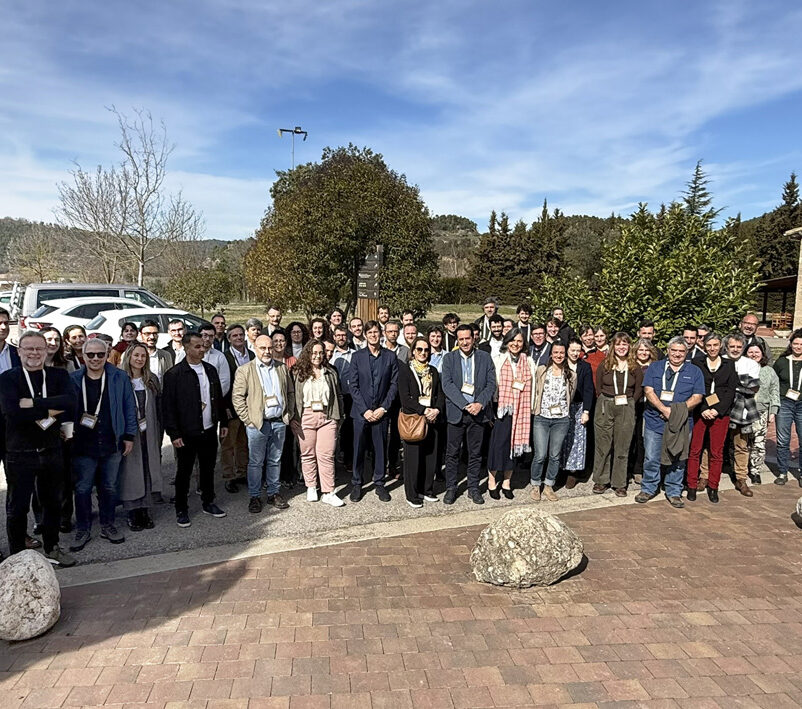
EU experts recognize the importance of prevention, governance, and financing to enhance the resilience of protected areas.
Over 60 representatives from 12 countries advance integrated wildfire management under the new EU Nature Restoration Regulation.
A three-day EU-wide event hosted at the Forest Science and Technology Centre of Catalonia (CTFC) in Solsona brought together institutions, practitioners, and policymakers to advance integrated wildfire risk management across Natura 2000 and other protected areas. The program combined plenary sessions, thematic working groups, and a field visit to the Montserrat Natural Park, allowing participants to debate policy measures while visiting on-ground practical prevention and restoration actions.
Co-organized with the European Commission’s Directorate-General for the Environment and with the support of the Spanish Ministry for the Ecological Transition and the Demographic Challenge, the meeting focused on aligning wildfire prevention with biodiversity conservation and ecosystems restoration. Discussions emphasized the need for approaches that reinforce ecological integrity while addressing rising wildfire risk. In her welcoming address, commissioner Jessika Roswall encouraged participants to pursue coordinated solutions aligned with EU biodiversity and climate objectives.
The event convened 65 participants from ten EU Member States, the United Kingdom, and the United States, including protected area managers, firefighters, scientists, technical experts, and public authorities. Their exchanges centered on practical solutions within the current EU policy context, particularly the implementation of the Nature Restoration Law and the development of National Restoration Plans. The key insights that emerged during the thematic working groups produced recommendations on prevention, governance, decision support, communication, and financing.
Participants agreed that wildfire prevention and biodiversity conservation are mutually reinforcing. Measures such as prescribed burning, grazing, silvicultural treatments, and structurally diverse forest restoration were recognized as legitimate nature-based solutions. Traditional land use and rural communities were seen as integral for the implementation of ecosystem-based prevention.
The debate around governance and permits highlighted how the fragmented responsibilities across forest, environment and civil protection authorities remain a challenge. Participants called for stable coordination structures, explicit inclusion of wildfire prevention in protected area management plans, and alignment of responsibilities with financing mechanisms.
Regarding integrated fire management and decision support, prescribed fire was framed as a pivotal tool within a broad management toolbox worth utilizing. Participants highlighted the need to combine habitat assessments with wildfire risk mapping, improve data-sharing, and ensure robust monitoring using biomass reduction metrics and selected bio-indicators.
Finally, public acceptance and sustainable financing were identified as decisive factors to improve engagement and financing. Early communication, demonstration projects, and collaborative financing models involving authorities, landowners, and utilities were emphasized, alongside the importance of sustaining rural livelihoods as a foundation for long-term prevention.
A shared direction for Europe
Participants converged on the need to integrate wildfire risk management into protected area planning and National Restoration Plans, develop a concise indicator framework for fire–biodiversity co-benefits, and reflect regional cost realities in EU funding instruments. The meeting organizers highlight the importance of “breaking sectorial silos” and ensuring that fire management is recognized as an integral component of landscape management.
A forthcoming European Commission Communication on Integrated Wildfire Risk Management is expected to provide additional guidance for scaling prevention and post-fire restoration across Europe. The event hosted by the CTFC demonstrated the value of bringing together practitioners, conservation experts and policymakers to build shared ownership of solutions and strengthen cooperation across governance levels.
Last modified: 18 March 2026