


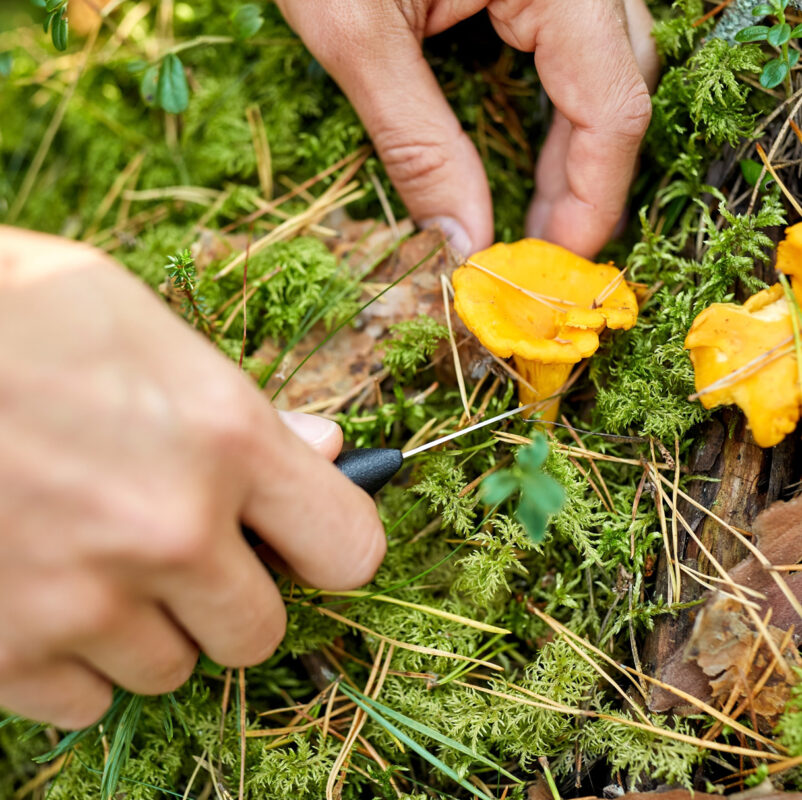
Non-wood forest products (NWFPs)—like mushrooms, cork, resin, pine nuts, chestnuts, and mastic— are an important part of rural economies in forest-rich areas across Spain.
They generate income, support local livelihoods, and provide nature-based alternatives to materials derived from fossil fuels.
As Europe moves toward a forest-based bioeconomy, NWFPs are becoming increasingly important. Yet, despite their growing importance, little is known about the people who harvest these products. This lack of knowledge may limit the design of effective policies and strategies to support a fair, resilient, and sustainable forest-based bioeconomy.
To address this gap, the IMFOREST study led by CTFC sheds light on the profiles, challenges, and opportunities of commercial harvesters across the country. CTFC jointly with COSE, CSIC-INIA and CESEFOR interviewed NWFP harvesters and their employers.
A flexible, often invisible workforce
Most NWFP harvesters operate either as self-employed individuals or small-scale entrepreneurs. Only a few, mainly in resin tapping, work full time in a single product. For most, harvesting is a seasonal or complementary income source alongside forestry or completely different jobs. Because of this informal and seasonal nature, these workers often remain invisible in official statistics, making it difficult to understand the sector or design effective policies.
Social networks matter more than formal entry paths
One of the most important factors for entering this sector is social capital—knowing someone already involved. Many harvesters begin through family ties or local contacts rather than formal training or recruitment systems. This reliance on networks can limit access for newcomers and shape who participates, reinforcing existing social patterns within the industry.
A male-dominated sector—with some exceptions
The typical harvester is male, reflecting long-standing cultural norms around forestry work. Women are present but mainly in specific activities like mushroom, chestnut, and resin collection—these being activities that can self-organise and better match family-work balance. These gender patterns are not only physical but also cultural: forestry-related work is often perceived as masculine, which may discourage broader feminine participation.
Migrants play a key role
In many regions, migrant workers make up an important part of the NWFP harvesting workforce. Their presence tends to mirror local demographics—areas with higher migrant populations also see more migrant harvesters. Less regulated or more informal harvesting activities can be easier for migrants to access, especially when other employment opportunities are limited.
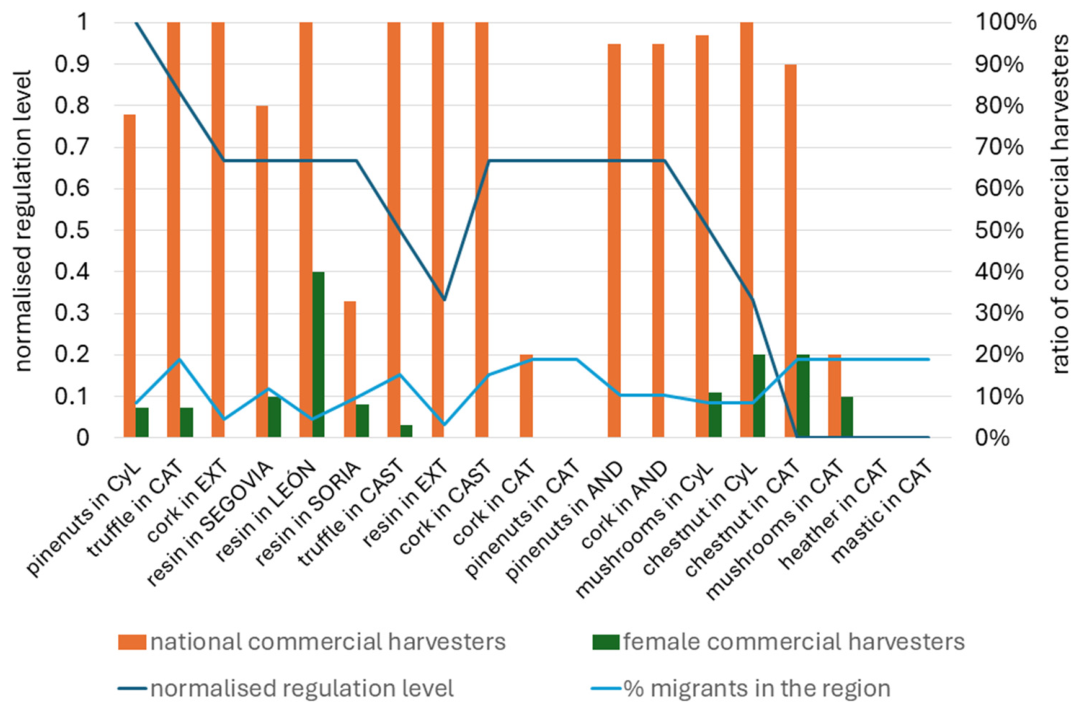
Figure 1 – Harvesters’ ratio per gender (% women) and origin (% nationals) and normalised regulation level in different Spanish regions: AND: Andalusia, CAT: Catalonia, CyL: Castilla-and-Leon, EXT: Extremadura, CAST: Castellón.
Access to land is crucial
Unlike some countries, in Spain forest products belong to landowners, meaning harvesters must secure permission to collect them. For those who do not own land, this entails additional efforts: they need negotiation skills, administrative capacity, or local connections to gain access. This makes natural capital (as right to resource harvesting) a key factor in success.
Skills range from basic to highly specialised
Not all harvesting jobs are equal. Some activities, like mushroom or chestnut picking, require relatively simple skills. Others, such as cork extraction or resin tapping, demand specialised knowledge and precision to avoid damaging trees. In these more technical sectors, training and experience become essential (human capital)—and can limit entry for newcomers.
Equipment and investment can be a barrier
Certain activities require specific tools or machinery, which represent an upfront investment. This “built capital” can be a major barrier to entry, especially for people with limited financial resources.
Why this matters
Making this workforce visible is essential for the future of NWFP value chains and for policies that support the transition to a forest-based bioeconomy in Europe. Without a clearer understanding of who harvests these products, under what conditions, and with what barriers, it is difficult to attract new workers, improve training, ensure fair labour conditions, or support newcomers without family or local networks.
It also matters for sustainable forest management. Clearer rules on access to land and harvesting rights can help reduce conflicts between landowners, harvesters, and companies. At the same time, better recognition of harvesters’ skills can support more sustainable practices, especially in activities that require technical knowledge.
Last modified: 30 June 2026