


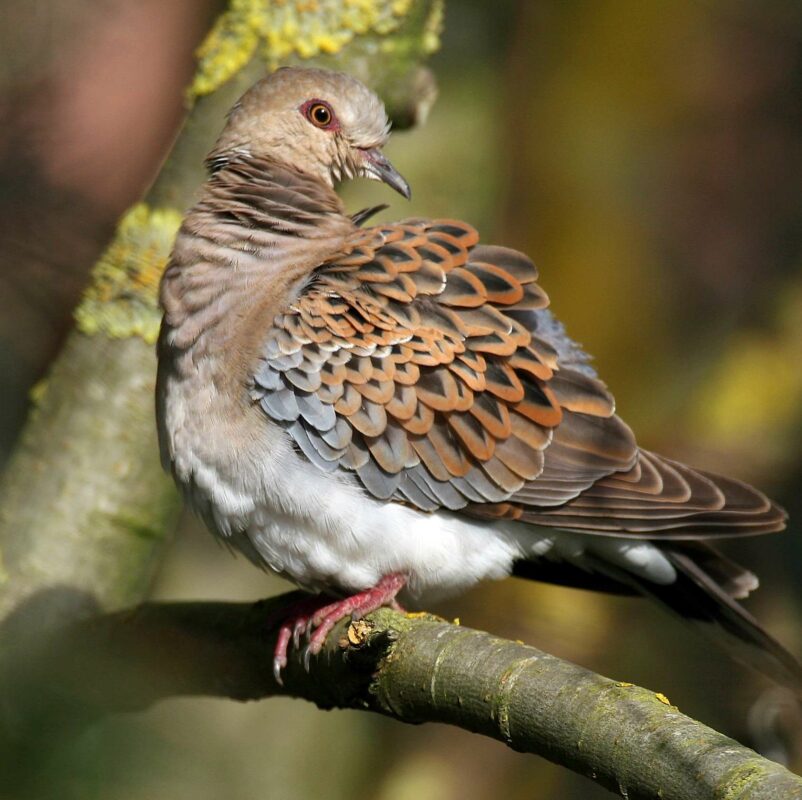
New research has found no detectable morphological or genetic differences between the two European Turtle-dove subspecies traditionally recognized in the western Mediterranean.
The findings call for a reassessment of current conservation and management strategies for the species.
For more than a century, ornithologists have divided European turtle dove populations in the western Mediterranean into two distinct subspecies. The nominate subspecies, Streptopelia turtur turtur, was considered to occur across most of continental Europe and the Canary Islands, while S. t. arenicola was thought to inhabit North Africa and certain Mediterranean islands, including the Balearic Islands. The latter was traditionally described as a desert-adapted form, characterized by a paler plumage and smaller body size. However, this classification was based almost entirely on fragmentary morphological observations made during the late nineteenth and early twentieth centuries, without support from modern molecular evidence.
To address this long-standing uncertainty, a team of researchers led by the Centre de Ciència i Tecnologia Forestal de Catalunya (CTFC), with the participation of the Research Group in Wildlife Ecology and Management of the Instituto de Investigación en Recursos Cinegéticos (IREC – CSIC, UCLM, JCCM), together with several institutions from Spain and Morocco, set out to rigorously test this taxonomic boundary. During the breeding season, the researchers captured more than 900 European Turtle-doves in Castilla-La Mancha, Catalonia, the Canary Islands, Menorca, Ibiza, and Morocco, analyzing both body measurements and mitochondrial DNA. Their findings have just been published in the prestigious journal Bird Conservation International.
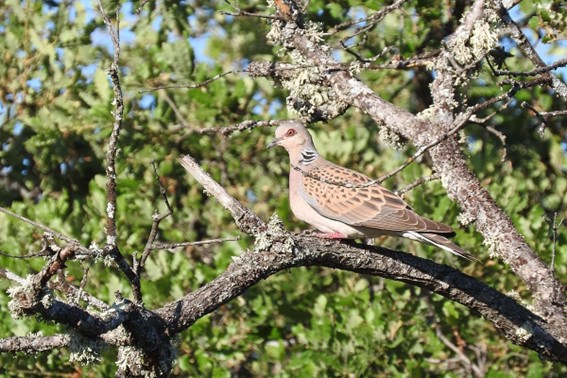
Overhunting and the degradation of the European Turtle-dove’s breeding and foraging habitats have driven the species’ dramatic population decline. A temporary hunting moratorium implemented in four European countries between 4 and 2021 has allowed populations to recover rapidly.
Neither morphology nor genetics distinguish them
The morphometric analysis of 647 adult birds—including measurements of wing, tail, and tarsus length—revealed no statistically significant differences between the two supposed subspecies. Principal Component Analysis (PCA) and Linear Discriminant Analysis (LDA) showed an almost complete overlap between the groups, disproving the long-held belief that North African Turtle-doves are smaller than their European counterparts.
The genetic analyses reached the same conclusion. After sequencing three mitochondrial genes in 117 individuals—and comparing the results with sequences from breeding populations in France, the United Kingdom, and Bulgaria—the researchers found no genetic structure consistent with the traditional distinction between the two subspecies. In fact, genetic variation within the subspecies S. t. turtur was greater than the variation detected between the two putative subspecies. The resulting haplotype network displayed a star-like topology with no association between haplotypes and the geographic origin of the samples. Overall, the findings point to extensive genetic connectivity between populations on both sides of the Strait of Gibraltar.
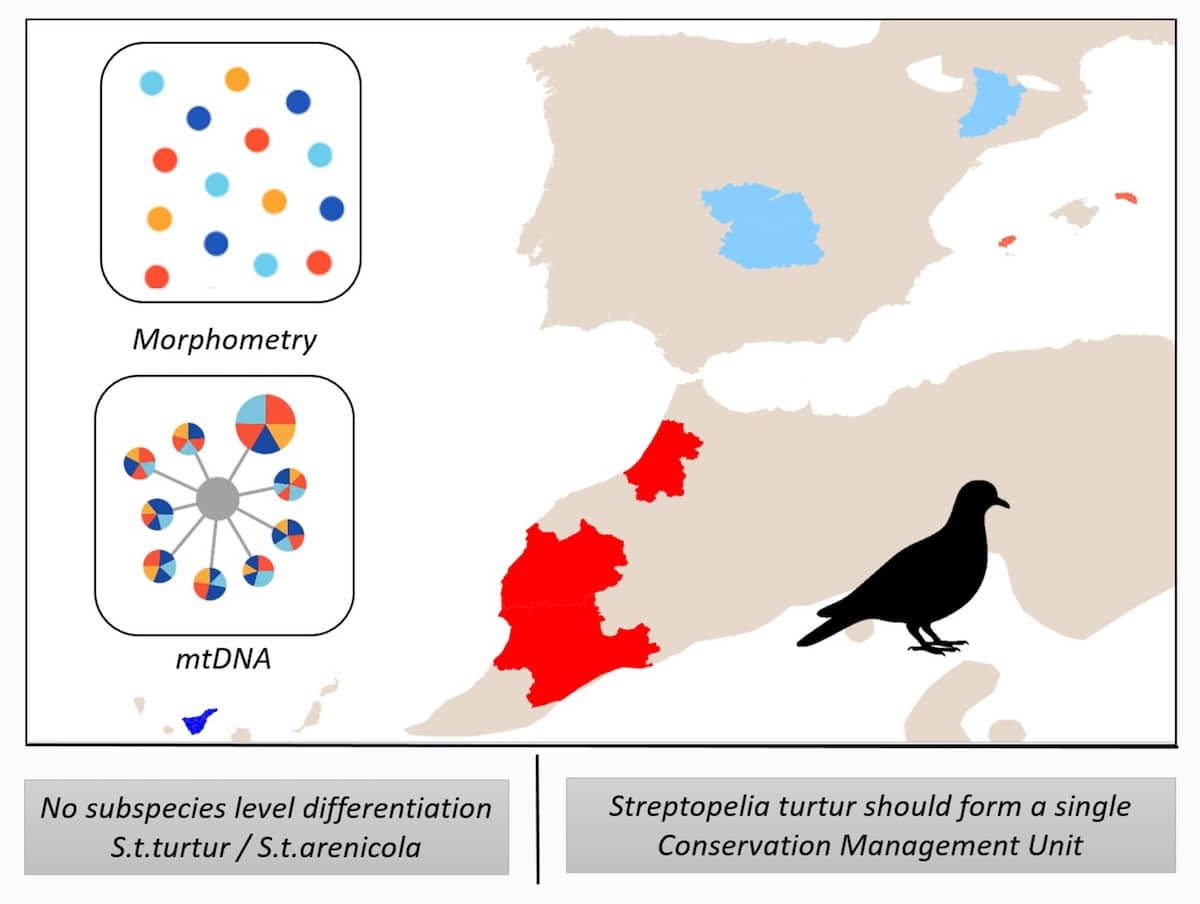
Graphic abstract of the research work
Migration as a homogenizing force
Why are there no clear genetic boundaries if these breeding populations are separated by the Mediterranean Sea? According to the authors, the most likely explanation is the occasional exchange of individuals between breeding populations. Although most European Turtle-doves return to the same breeding areas each year, a small proportion may breed in a different location from where they were born or nested in previous seasons. This process may be facilitated by stopovers at other breeding areas during migration. Even if such exchanges occur only occasionally, they are sufficient to maintain gene flow between populations. In fact, only a few dispersing individuals per generation are needed to prevent populations from becoming genetically differentiated. As a result, the Mediterranean Sea has probably not acted as a strong enough barrier—or for a long enough period—to promote the evolution of distinct subspecies.
Implications for European Turtle-dove conservation
The European Turtle-dove is a globally threatened species. Between 1980 and 2023, its populations declined by 83%, mainly due to habitat loss and unsustainable hunting pressure. The adaptive harvest management plans promoted by the European Commission are organized around migratory flyways, treating the entire flyway population as a single management unit. Although these management plans apply only within European Union Member States, it has long been recognized that hunting pressure in Morocco—where the European Commission has no regulatory authority—may also affect European breeding populations. The findings of this study reinforce that view. The extensive gene flow detected between Turtle-doves breeding in Spain and Morocco, together with the absence of morphological or genetic differences supporting the existence of two distinct subspecies, indicates that these birds belong to a single, biologically connected population.
Furthermore, if Moroccan Turtle-doves are part of the same genetic unit as those breeding in Spain,the country’s substantial breeding population could serve as a demographic reservoir for the conservation of the species, helping to reinforce other populations connected through gene flow in the future.
The authors call for a reassessment of the Turtle-dove’s subspecific status using more comprehensive genomic data. They also stress the urgent need to expand conservation strategies beyond Europe’s borders by coordinating conservation efforts with North African countries.
From a conservation biology perspective, the European Turtle-dove highlights the importance of maintaining an up-to-date taxonomy. The authors argue that incorporating molecular evidence can help prevent conservation strategies from treating as independent units populations that, biologically, belong to the same interconnected system. Integrating genetic information into conservation planning can therefore help define conservation units that more accurately reflect the true biological structure of wild populations.
More information:
Domínguez, J. C., Bota, G., García, J. T., Arroyo, B., Hanane, S., Escandell, R., Sardà-Palomera, F., Ichen, A., Moreno-Zarate, L. 2026. No subspecies, no borders: morphometric and mitochondrial DNA evidence in western Mediterranean European Turtle-doves. Bird Conservation International 36, e25, 1-12.
Last modified: 14 July 2026