


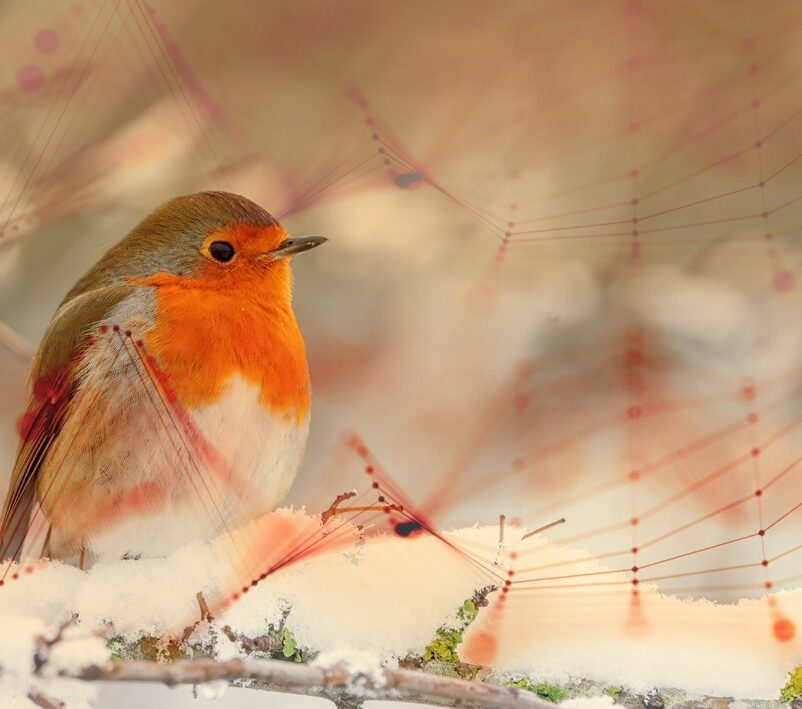
A new global database with over 90,000 bird songs allows to train algorithms to identify species.
The project opens the door to a new way of monitoring biodiversity by combining scientific knowledge and artificial intelligence technology.
Biodiversity monitoring is entering a new digital era. A research team led by the Forest Science and Technology Centre of Catalonia (CTFC) has published the first global database of bird songs annotated in detail. A pioneering tool that will improve automatic species‑recognition systems based on artificial intelligence.
The article, published in the journal Ecology as a data paper, gives the scientific community an unprecedented collection of bird recordings gathered from 72 locations around the world. In each file, local ornithology experts have manually indicated the exact moment when each species sings: over 1,100 different species and a total of more than 90,000 vocalizations. The dataset is open access and available on Zenodo.
An open resource for global science
The value of this work lies in its collaborative dimension and its immediate usefulness. The annotations, made by ornithologists with direct knowledge of local species, provide exceptional reliability to the dataset. In addition, the fact that it is a global and free resource allows scientists to use it to create or test automatic species‑detection algorithms, such as acoustic recognition systems based on machine learning.
“With this initiative, the scientific community has a new foundation to evaluate and improve the accuracy of existing tools like BirdNET or to design new models capable of identifying species for which there were not enough data until now,” explains Cristian Pérez‑Granados, first author of the article and head of the CTFC research group New tools for biodiversity monitoring. In fact, this database has already been used to evaluate, at a global scale, the performance, and best parameters for running BirdNET, a tool capable of automatically identifying more than 6,000 bird species.
Science, technology, and conservation
The combination of field observation and artificial intelligence techniques opens new possibilities for automated biodiversity monitoring, a key challenge at a time when ecosystems are changing rapidly. These types of tools make it possible to collect continuous and large‑scale information about the presence of species in different regions, without relying exclusively on human effort.
“Automatic systems will not replace ornithologists, but they can multiply their observation capacity. Our goal is to put data and expert knowledge at the service of a more open, efficient, and reproducible science,” Pérez‑Granados highlights.
These kinds of advances will make it possible to detect changes in bird populations or the arrival of invasive species earlier, improving the response to biodiversity loss.
More info: https://esajournals.onlinelibrary.wiley.com/doi/10.1002/ecy.70317
Last modified: 12 February 2026